|
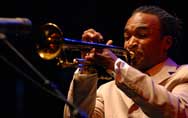
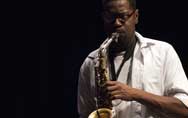
Abram Wilson, Soweto Kinch &
Band
@ Queen Elizabeth Hall
19 November 2006
Click an image to enlarge.
Abram Wilson biography
Trumpeter/ composer/ bandleader / educator/
actor Abram Wilson died of cancer on 9 June 2013. He continued performing
as long as he could, despite acute pain until his last gig in Teignmouth,
Devon on May 24.
Born in Fort Smith, Arkansas in 1975, Abram Wilson
was raised along with his four brothers and one sister in New Orleans,
Louisiana. The eldest of six children, the entire family including
mother, Doris Wilson, and father, Willie C Wilson Jr, had some experience
in music. Wilson’s first inspiration and introduction to music
was at the age of five when listening to his father play the guitar
and to recordings which his father would play. Soon after being
bought a snare drum for Christmas, Wilson went on to play drums.
At nine, Wilson received his first trumpet and after being taught
his first note by his mother, he immediately began learning songs
from the radio and developing his own method of ear training.
Starting with his first instructor, Lester Wright,
Wilson quickly became the most advanced in the class, surpassing
many of the older students. At 13, he began to display the ability
to lead, and was elected to front his 75-piece school band as drum
major. That same year, Wilson auditioned for the New Orleans Center
For Creative Arts (NOCCA), a school specialising in jazz and classical
music, among other art forms, and responsible for producing artists
such as Wynton Marsalis, Terence Blanchard, Harry Connick Jr, Donald
Harrison, Delfayo Marsalis, and Nicholas Payton, all of whom graduated
from the school. Whilst there Wilson studied under the tutelage
of Clyde Kerr Jr, Ronald Benko, Dr Burt Breaud, and band director,
Augustus Walker at O Perry Walker Sr High School, all of whom would
further shape his musical direction and raise it to a new level.
In 1991, Wilson graduated from both schools and was ready to take
on new parts of the world.
At 17, Wilson was teaching trumpet privately and
soon earned a music scholarship to Ohio Wesleyan University. Here,
he studied classical trumpet with Larry Griffin and at 22, graduated
with a bachelor’s degree in music education, qualifying him
to teach both choral and instrumental music from kindergarten to
college aged students. Wilson went on to study at the world-renowned
Eastman Conservatory in Rochester, New York where he attained his
masters, studying jazz performance and composition with Ralph Alessi,
Mike Cain, and Fred Sturm, and classical trumpet with Barbara Butler.
It was also during this time Wilson became closely involved with
Young Audiences, an organization which brought professional artists
to schools to perform and conduct workshops for children. Wilson
soon found himself performing for groups of up to 250, dealing with
subjects like jazz history, groove, music theory, improvisation,
and music composition. These workshops proved to be amazingly successful
in Rochester, Cleveland and New York and inspired a number of students
to pursue careers in music.
Upon graduating from Eastman, Wilson moved to New
York where he started his own band incorporating both his vocal
and trumpet skills, and continued to promote music education throughout
the schools there. By now he was regularly performing with the Roy
Hargrove Big Band and with rhythm and blues legend, Ruth Brown,
appearing on her “Good Day for the Blues” release in
1999.
Coming to London in 2002, Wilson quickly made links
to some of the best artists here and, before long, was booked to
appear as part of the Julian Joseph Big Band. A chance meeting with
the directors of Dune Records at a jam session at London’s
Jazz Café set the wheels in train for Wilson to start working
as regular member of various Dune artists’ bands leading to
Wilson being signed to the label in late-2003. He appears and currently
tours with fellow Dune recording artists: Soweto Kinch on the 2003
Mercury/ MOBO Award winning album, “Conversations With The
Unseen; with 2002 Mercury/MOBO Award winner, Denys Baptiste on “Let
Freedom Ring!” with soul-jazz vocalist, Juliet Roberts; and
the award-winning jazz/ska big band, Jazz Jamaica All Stars.
As well as being an excellent trumpeter, Wilson
is also an excellent singer/songwriter whose voice is a finely wrought
instrument enabling him to cover all styles of music, from jazz
scat to rap, from ballads to boogaloo, RnB to hip hop, reggae and
ska to soul. As a composer, he has a broad range of skills, being
able to write for string orchestra and big band, as well as small
ensembles. He also regularly works with the hip/RnB/soul production
team, Seulja, where he primarily undertakes vocal and instrumental
arranging.
Wilson is also an experienced music teacher and
educator. He was Head of Music at a London school, a post he held
for two years and, being keen to maintain his role as an educator.
In 2004, Wilson was appointed Artist In Residence
for Tomorrow’s Warriors Ltd – the sister company of
Dune specialising in youth jazz education and professional artist
development – for the period 2004-2007. This appointment has
resulted in Wilson leading on several education projects in the
UK and overseas for children and young people.
In 2005, Wilson was nominated for the BBC Award
for Best Band and for the MOBO Award for Best Jazz Act 2005 (along
with label mate and saxophonist Soweto Kinch).
In August/September 2005, Wilson was special guest
with Soweto Kinch’s band on a 5-date tour of the USA taking
in New York (Charlie Parker Festival in Harlem and The Jazz Gallery
in Manhattan), Philadelphia (Clef Club), Atlanta (the Montreux Festival
in Atlanta), and Chicago (African Festival for the Arts). Due to
illness, Kinch was unable to play saxophone and so played piano
instead, leaving Wilson to take more of a leading role on the tour.
Audiences were clearly impressed as evidenced by the queues to buy
his album!
In March 2006, Wilson was appointed Assistant Artistic
Director for Tomorrow’s Warriors. Working alongside the Artistic
Director, Gary Crosby, Wilson is now responsible not only for the
company’s education programme but also for the professional/artistic
development of members of the company’s core bands, and the
live music programme.
In April 2006, Wilson was pronounced winner of
the top prize in the Jazz Category of the prestigious International
Songwriting Competition in Nashville, TN beating off competition
from almost 1,000 entries from 29 countries with his outstanding
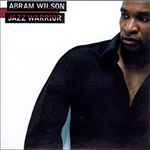
track, Monk, taken from his Jazz Warrior album.
Wilson is a performer with astounding drive and
energy. He continues to explore new avenues - combining gospel,
soul, blues, jazz and hip-hop, producing music with a fresh exciting
edge.
Soweto Kinch biography
Born in London, England on 10 January 1978 to a
Barbadian father and British-Jamaican mother, Soweto Kinch is one
of the most exciting and versatile young musicians to hit the British
jazz scene in recent years.
He first became interested in music at the tender
age of eight, playing clarinet at primary school. He quickly developed
a fondness for the alto saxophone and was given his first instrument
when he was nine. After meeting Wynton Marsalis four years later
he discovered and became passionate about jazz, first concentrating
on piano and later, in his teens, focusing on alto saxophone.
His family had a strong artistic influence on him,
his father being a playwright and his mother an actress. Having
such a theatrical background exposed him to performance and meant
that he was often surrounded by musicians and other artists such
as jazz tap dancer Will Gaines and percussionist/bebop vocalist
Frank Holder.
Kinch is essentially a self-taught musician who
has supplemented his musical education by gathering information
from books and transcribing jazz recordings. He has also been fortunate
to attract the attention of two of the most important jazz luminaries
in Britain, saxophonist Courtney Pine OBE and double bassist Gary
Crosby, both of whom are now key mentors. In addition to the alto
saxophone, Kinch plays soprano, tenor and baritone saxophones, bass
clarinet, and piano. He also raps and is competent on the computer,
using sequencers such as Cubase, Logic Audio, and Sibelius.
Kinch made the practical decision to become a full
time musician fairly recently. Graduating from Oxford University
in 1999 with a BA in Modern History, he was set to pursue a career
in journalism or to undertake post-graduate studies. However, the
offer of a place within the core band of Tomorrow's Warriors (the
development programme established by Gary Crosby in 1991 to nurture
and develop talented young jazz musicians) and with Crosby's professional
bands, Jazz Jamaica and Nu Troop persuaded him to choose music as
a career path.
Kinch’s musical influences are as broad as
they are diverse. He particularly admires Sonny Rollins for his
innovative style and successful appropriation of West Indian music
within the jazz canon. Most recently, Kinch has been influenced
by baroque and early classical music due to an interest he has in
the 17th and 18th century black population of Britain. He is keen
to reconstruct the African and classical influences that this community
would have had.
Kinch made his first appearance on record in October 2001 as a member
of the internationally acclaimed Jazz Jamaica All Stars, a 20-piece
big band blending jazz with reggae, ska and other Caribbean rhythms.
In July 2002, Kinch won the inaugural White Foundation
International Saxophone Competition at the Montreux Jazz Festival.
Hot on the heels of this major award, Kinch picked up the prestigious
BBC Radio Jazz Award for Rising Star 2002 and, as a member of Jazz
Jamaica All Stars, shared in the glory of the BBC Radio award for
Best Band 2002.
Kinch is pursuing an interest in Theatre. He completed
a commission with NITRO Black Theatre Cooperative in November 2001
for whom he composed a score for ‘Slamdunk’ (performed
at The Contact Theatre, Manchester). Similarly, he composed the
score for a production in Birmingham, ‘Its Just A Name’
produced by Nu Century Arts (April 2002) and written by his father
Don Kinch.
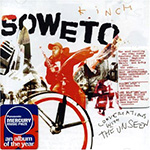
Kinch’s debut album “Conversations
With The Unseen” was released in 2003. The album won a Mercury
Music Prize for An Album Of The Year and earned him the MOBO Award
for Best Jazz Act 2003. Kinch was also announced as the winner of
the Peter Whittingham Award for Innovative Jazz Project the same
year.In 2004, Kinch continued international touring and picked up
BBC Radio Jazz Awards for Best Band and Best Instrumentalist.
Yet another prestigious award came in November
2004, with Kinch winning the Urban Music Award for Best Jazz Act.
All categories of these awards were nominated and voted for online
by the public and Kinch received a record number of votes!
|







































cr_150prev.jpg)
bwred_150preview.jpg)