|
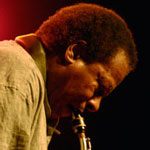
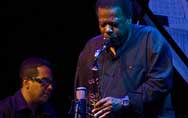
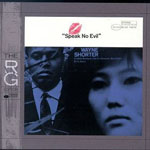
Wayne Shorter Quartet
@ the Barbican Centre
17 November 2013 - 8 October 2011 - 25 April 2008
Click an image to enlarge.
Biography
Born in Newark, New Jersey on August 25, 1933,
Wayne Shorter had his first great jazz epiphany as a teenager:
“I remember seeing Lester Young when
I was 15 years old. It was a Norman Granz Jazz at the Philharmonic
show in Newark and he was late coming to the theater. Me and a couple
of other guys were waiting out front of the Adams Theater and when
he finally did show up, he had the pork pie hat and everything.
So then we were trying to figure out how to get into the theater
from the fire escape around the back. We eventually got into the
mezzanine and saw that whole show - Stan Kenton and Dizzy Gillespie
bands together on stage doing ‘Peanut Vendor,’ Charlie
Parker with strings doing ‘Laura’ and stuff like that.
And Russell Jacquet...Ilinois Jacquet. He was there doing his thing.
That whole scene impressed me so much that I just decided, ‘Hey,
man, let me get a clarinet.’ So I got one when I was 16, and
that’s when I started music.”
Switching to tenor saxophone, shorter formed a
teenage band in Newark called The Jazz Informers and later got some
invaluable bandstand experience with the Jackie Bland Band, a progressive
Newark orchestra that specialised in bebop. While still in high
school, Shorter participated in several cutting contests on Newark’s
jazz scene, including one memorable encounter with sax great Sonny
Stitt. He attended college at New York University while also soaking
up the Manhattan jazz scene by frequenting popular nightspots like
Birdland and Cafe Bohemia. Shorter worked his way through college
by playing with the Nat Phipps orchestra. Upon graduating in 1956,
he worked briefly with Johnny Eaton and his Princetonians, earning
the nickname “The Newark Flash” for his speed and facility
on the tenor saxophone. But just as he was beginning making his
mark, Shorter was drafted into the Army. He recalls a memorable
jam session at the Cafe Bohemia just days before he was shipped
off to Fort Dix, New Jersey.
“A week before I went into the Army
I went to the Cafe Bohemia to hear music, I said, for the last time
in my life. I was standing at the bar having a cognac and I had
my draft notice in my back pocket. That’s when I met Max Roach.
He said, 'You’re the kid from Newark, huh? You’re The
Flash.' And he asked me to sit in. They were changing drummers throughout
the night, so Max played drums, then Art Taylor, then Art Blakey.
Oscar Pettiford was on cello. Jimmy Smith came in the door with
his organ. He drove to the club with his organ in a hearse. And
outside we heard that Miles was looking for somebody named Cannonball.
And I’m saying to myself, 'All this stuff is going on and
I gotta go to the Army in about five days!"
Following his time in the service, Shorter had
a brief stint in 1958 with Horace Silver and later played in the
house band at Minton's Playhouse in Harlem. It was around this time
that Shorter began jamming with fellow tenor saxophonists John Coltrane
and Sonny Rollins. In 1959, Shorter had a brief stint with the Maynard
Ferguson big band before joining Art Blakey and the Jazz Messengers
in August of that year. He remained with the Jazz Messengers through
1963, becoming Blakey's musical director and contributing several
key compositions to the band's book during those years. Shorter
made his recording debut as a leader in 1959 for the Vee Jay label
and in 1964 cut the first of a string of important recordings for
the Blue Note label. He joined the Miles Davis band in 1964 and
remained with the group through 1970, contributing such landmark
compositions as “Nefertiti,” “E.S.P.,” “Pinocchio,”
“Sanctuary,” “Fall” and “Footprints.”
In 1970, Shorter co-founded the group Weather
Report with keyboardist and Miles Davis alum, Joe Zawinul. It remained
the premier fusion group through the 1970’s and into the early
1980’s before disbanding in 1985 after 16 acclaimed recordings,
including 1980’s Grammy Award-winning double-live LP set,
“8:30”. Shorter formed his own group in 1986 and produced
a succession of electric jazz albums for the Columbia label. After
the tragic loss of his wife in 1996 (she was aboard the ill-fated
Paris-bound flight TWA 800), Shorter returned to the scene with
1997's “1+1”, an intimate duet recording with pianist
and former Miles Davis quintet band mate Herbie Hancock. The two
spent 1998 touring as a duet and by the summer of 2001 Wayne began
touring as the leader of a talented young line-up featuring pianist
Danilo Pérez, bassist John Patitucci.
More than half a century after embarking on his
lifelong musical adventure, Shorter is universally regarded as a
living legend in jazz. His great body of work as a composer for
such illustrious groups as Art Blakey’s Jazz Messengers, Miles
Davis’ famous mid ‘60s quintet and fusion supergroup
Weather Report is enough to ensure him a spot in the Jazz Hall of
Fame. But if the prolific composer had never written a single tune,
his signature sound and choice of notes, sense of economy and unparalleled
expression on both tenor and soprano saxes would have earmarked
him for greatness. Combine the writing prowess with the fragmented,
probing solos and the enigmatic Buddhist philosopher presence and
you have the makings of a jazz immortal.
“Life is so mysterious, to me,”
says Shorter. “I can’t stop at any one thing to say,
‘Oh, this is what it is.’ And I think it’s always
becoming, always becoming. That’s the adventure. And imagination
is part of that adventure.”
|





























.jpg)
.jpg)
cr.jpg)
.jpg)
cr.jpg)
.jpg)
.jpg)
.jpg)
.jpg)
cr.jpg)


_150prev.jpg)
bw_150prev.jpg)