|
Michel Portal
@ the Queen Elizabeth Hall
4 November 2011
Featured musicians: Michel
Portal – saxophones,
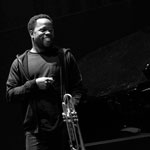
Ambrose Akinmusire – trumpet, Bojan Zulfikarpašic –
keyboards & piano, Scott Colley – bass & Nasheet Waits
- drums
Click an image to enlarge.
Biography
Some human beings and particularly some artists
just cannot be fitted in any classification or definition. About
Michel Portal, clarinettist and saxophonist (but also bandonion
player), classical interpret and jazzman (but also composer), Francis
Marmande outlined in 1981 the portrait of a “permanent exile
who feels constantly pending”; almost a way to deny any fixed
but illusive close definition of his identity. That is to say, the
only way to try to grasp the musician’s singularity is a portrait
.... in the plural ; A paradox which allowed Lucien Malson in 1972
to have recourse to the Greek mythology ; " Proteus, this is
already him : many artists in one, one man under different appearances
". Is the key to these always transitory belongings a radical
anxiety, humanly and musically speaking? It is probably not by accident
that one of the tunes in his record Any Way (released in 1993) is
called Intranquilo, an adjective meaning anxiety in the Spanish
language, Spain being a country dear to this artist from Bayonne,
but also in the language of the Portuguese Fernando Pessoa ; the
" desassossego " on which is based his book livre de l’intranquillité
should not be unfamiliar to the clarinettist’s universe. The
route of this musician is a constant challenge to any formal biography:
he was indeed awarded the first clarinet prize of the Conservatoire
de Paris in 1959, then those of the Geneva and Swiss jubilee competitions
(1963), as well as the prize of the Budapest competition (1965);
this did not prevent him to play in dance bands (Perez Prado, Aimé
Barelli, ...) after having played since his childhood the popular
music of his Bask Land (he was born in Bayonne on November 25th,
1935). During the 60’s, he played in the most various musical
universes: orchestras accompanying famous French pop stars to those
entertaining the Lido or the Folies Bergères. He enjoys the
musician “profession” in all its prosaism and diversity.
But he also takes part in jazz orchestras, to play
the music of Pierre Michelot, Jef Gilson, Jean-Luc Ponty, Ivan Jullien
or André Hodeir...Simultaneously, he gets involved in free
jazz as soon as this movement is expressed on French stages, notably
alongside the pianist François Tusques, the trumpeter Bernard
Vitet or the American drummer Sunny Murray. At the same time, he
imposes himself as the indispensable interpret for contemporary
composers, who find in the amazing extent of his technique and in
his musical intelligence the ideal mediator on this difficult instrument,
the clarinet. His multiple participation in Diego Masson’s
Musique Vivante Ensemble, notably for Domaines by Pierre Boulez,
and his cooperation with numerous composers such as Luciano Berio,
Mauricio Kagel, Karlheinz Stockhausen or Vinko Globokar (who dedicates
to him Ausstrahlungen) shed light on this role. With Globokar, who
is also a trombonist, he performs as soon as 1969 within the New
Phonic Art, a band of “contemporary improvised chamber music”
they had created with the pianist-composer Carlos Rogue Aisina and
the percussionist Jean-Pierre Drouet. The Michel Portal Unit is
born in 1971, an open structure devoted to free improvisation, meeting
point for many years of the most adventurous jazz and improvisation
musicians from America and Europe. This will not prevent the clarinettist
(most of the time in this universe as bass clarinettist or saxophonist)
to join great improvisers in different formulas (the most intimate
one being the duo). Without pretending to be exhaustive but in order
to stress the diversity of his partners, we may mention the saxophonists
John Surman, Anthony Braxton, Jean-Louis Chautemps, Harry Sokal,
Dave Liebman, Louis Sclavis, François Jeanneau ; the drummers
or percussionists Pierre Favre, Daniel Humair, Paul Motian, Han
Bennink, Mino Cinelu, Jack DeJohnette, Trilok Gurtu, André
Ceccarelli ; the bassists Jean-François Jenny-Clark, Leon
Francioli, Bob Guérin, Henri Texier, Charlie Haden ; the
pianists Martial Solal, Joachim Kühn, Andy Emler ; the guitarist
Claude Barthélemy, the organist Eddy Louiss, the violinist
Didier Lockwood, the trombonist Albert Mangelsdorff, the tuba player
and poly-instrumentalist Howard Johnson and, since the early days,
Bernard Lubat, the orchestra-man ; last but not least in a different
field the ballet-dancer Carolyn Carlson... This multiple activity
in all fields of contemporary music should not obviously shade the
importance of the classical clarinettist, soloist and chamber music
player, whose fame will be asserted later: In December 1975, the
Parisian Salle Pleyel finally welcomed him, while he has been for
already a long time wanted on the most important jazz or contemporary
music stages (Châteauvallon, Donaueschingen, Royan,...). From
now on, music critics and lovers rarely hesitate to recognize his
freedom as a “cross-over”, based on his insatiable appetite
for musical emotions leading him from one universe to the other.
And the most honest ones soon recognize that this diversity, far
from spoiling his instrumentalist quality, on the contrary enriches
his musicality and the expressed emotion.
In the field of chamber music, he thus plays with
the pianists Georges Pludermacher, Maria Joao Pires, Michel Dalberto,
Mikhail Rudy,..., the cellists Frédéric Lodéon,
Boris Pergamenschikow,..., the viola players Gérard Caussé,
Youri Bashmet, the quatuors Melos, Talich, Orlando....As a final
touch for this highly complex musician, we should not forget to
emphasize the importance of the movie composer: Michel Portal has
been actually for already a long time writing music for the cinema
and the television ; among this huge activity, we should particularly
mention his faithfulness to the film director and jazz critic Jean-Louis
Comolli (La Cecilia, 1975; L’ombre rouge, 1981; Balles perdues,
1983); last but not least, we should also remind the three César
prizes awarded for Le Retour de Martin Guerre (Daniel Vigne, 1981),
Les Cavaliers de l’Orage (Gérard Vergez, 1983) and
Champ d’Honneur (Jean-Pierre Denis, 1986).
Beyond the apparent border lines of his multiple
activity, what is striking with Michel Portal is a quasi ritual
invocation of solitude, coupled with a desperate desire to communicate,
to share: with the musicians he meets on stage, but also with the
audience. This high demand for a reaction, an involvement of the
other, is the legitimate expectation of a musician who constantly
and limitless invests himself neglecting any risk. This improviser
accepts with nobility and courage to play without a score but with
the risk and the anxiety resulting from it: what are we playing
now? The classical interpret is lucid enough to be faithful to the
score without hampering, according to Patrick Szernovicz, the establishment
of " an extraordinary, in the very sense of the word, climate,
made of impulses, but offering the original eagerness of the work
". His art in both fields is built through the intertwining
of dramatic tensions, merry breakaways resulting from his very seriousness;
written or improvised, his music seems to be unceasingly questioned.
And if he often turns to Africa for its irrepressible
rhythms, its merry spontaneity, Michel Portal also knows the secret
of Brahms’ transport. Constantly seized by a fruitful doubt,
he is aware that art cannot be obtained without this part of challenge
to all certainties.
|
.jpg)
.jpg)
.jpg)
.jpg)
.jpg)
.jpg)
.jpg)

.jpg)
.jpg)
.jpg)
.jpg)
.jpg)
.jpg)
bw.jpg)
bw.jpg)

|



























.jpg)

.jpg)
.jpg)
.jpg)
.jpg)
cr.jpg)
.jpg)