|
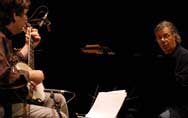
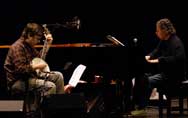
Chick Corea & Béla
Fleck
@ the Barbican Centre
19 November 2007
Click an image to enlarge.
Chick Corea biography
Born Armando Anthony Corea in Chelsea, Massachusetts
on June 12, 1941, Corea began studying piano at age four. Early
on in his development, Horace Silver and Bud Powell were important
piano influences while access to the music of Beethoven and Mozart
inspired his compositional instincts. Corea’s first major
professional gig was with Cab Calloway, which came before early
stints in Latin bands led by Mongo Santamaria and Willie Bobo (1962-63).
There followed important tenures with trumpeter Blue Mitchell (1964-66),
flutist Herbie Mann and saxophonist Stan Getz before Corea made
his recording debut as a leader in 1966 with “Tones for Joan’s
Bones” (which featured trumpeter Woody Shaw, tenor saxophonist
and flutist Joe Farrell, bassist Steve Swallow and drummer Joe Chambers).
After accompanying Sarah Vaughan in 1967, Corea
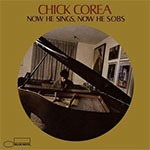
went into the studio in March of 1968 and recorded “Now He
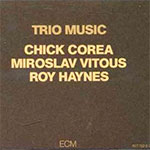
Sings, Now He Sobs” with bassist Miroslav Vitous and drummer
Roy Haynes. That trio album is now considered a jazz classic. In
the fall of 1968, Corea replaced Herbie Hancock in Miles Davis’
band. In September of that year, he played Fender Rhodes electric
piano on Miles' important and transitional recording “Filles
de Kilimanjaro”, which pointed to a fresh new direction in
jazz. Between 1968 and 1970, Corea also appeared on such groundbreaking
Davis recordings as “In a Silent Way”, “Bitches
Brew”, “Live-Evil” and “Live at the Fillmore
East”. He is also a key player in Davis’ electrified
ensemble that appeared before 600,000 people on August 29, 1970
at the Isle of Wight Festival in England (captured on Murray Lerner's
excellent documentary, Miles Electric: A Different Kind of Blue).
Shortly after that historic concert, both Corea and bassist Dave
Holland left Miles’ group to form the cooperative avant-garde
quartet Circle with drummer Barry Altschul and saxophonist Anthony
Braxton. Though its tenure was short-lived, Circle recorded three
adventurous albums, culminating in the arresting live double LP
“Paris-Concert” (recorded on February 21, 1971 for the
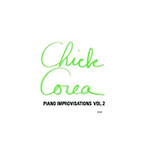
ECM label before Corea changed directions again. His excellent “Piano
Improvisations”, Vol. 1 and 2, recorded over two days in April
1971 for ECM, was the first indication that solo piano performance
would become fashionable.
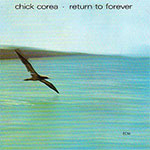
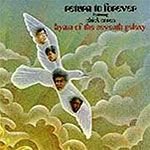
Toward the end of 1971, Corea formed his first
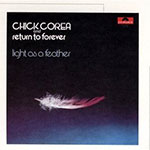
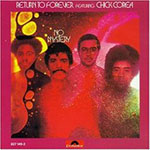
edition of Return To Forever with Stanley Clarke on acoustic bass,
Joe Farrell on soprano sax and flute, Airto Moreira on drums and
percussion and his wife Flora Purim on vocals.
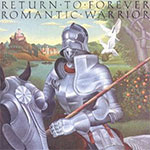
By early 1973, Return To Forever had taken a different
course. Following the addition of electric guitarist Bill Connors
and thunderous drummer Lenny White, the group was fully fortified
to embrace the emerging fusion movement with a vengeance. A third
edition of RTF featured a four-piece brass section along with bassist
Clarke, charter RTF member Joe Farrell, drummer Gerry Brown and
Chick's future wife Gayle Moran on vocals. Together they recorded
1977's “Music Magic” (Columbia) and the four-LP boxed
set R.T.F. “Live” (Columbia), which captured the sheer
energy and excitement of the full ensemble on tour.
The year 1982 was again marked by a flurry of creative
activity that yielded such gems as the Spanish-tinged Touchstone
(featuring flamenco guitar great Paco de Lucia and a reunion of
Corea's RTF bandmates Al Di Meola, Lenny White and Stanley Clarke
on the aptly-titled "Compadres"), the adventurous Again
and Again (a quintet date featuring the remarkable flutist Steve
Kujala), Corea's ambitious Lyric Suite for Sextet (a collaboration
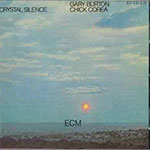
with vibraphonist Gary Burton augmented by string quartet) and The
Meeting (a duet encounter with renowned classical pianist Friedrich
Gulda). 1982 also marked the formation of the Echoes of an Era band
(essentially an all-star backing band for R&B singer Chaka Khan’s
first foray into jazz.
Through the remainder of the ‘80s and into
the early ‘90s, Corea returned to the fusion arena with a
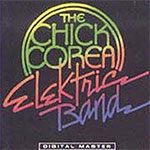
vengeance with his Elektric Band, featuring drummer Dave Weckl,
saxophonist Eric Marienthal, bassist John Pattitucci and guitarist
Frank Gambale.
By 1992, Corea had realised a lifelong goal in
forming Stretch Records. Among its early releases were projects
by Bob Berg, John Patitucci, Eddie Gomez and Robben Ford. In 1997,
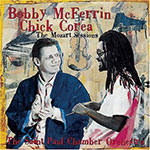
Corea released a recording with the St. Paul Chamber Orchestra with
Bobby McFerrin as conductor. Their second collaboration, entitled
“The Mozart Sessions” (Sony Classical) followed on the
heels of their first duet Grammy Award winning recording, 1991's
“Play” (Blue Note). That same incredibly productive
year (1977), Corea unveiled his acoustic sextet Origin (the band's
self-titled debut release was a live recording at the Blue Note
club in New York) and also teamed up with old partner Gary Burton,
rekindling their chemistry from the ‘70s on “Native
Sense-The New Duets”, which earned Corea his ninth GRAMMY®
Award.
In 2001, Corea unveiled his New Trio, featuring drummer Jeff Ballard
and bassist Avishai Cohen, on “Past, Present & Futures”.
By the end of that year, Corea was engaged with his ambitious three-week
career retrospective at the Blue Note.
In 2004, Corea reunited his high-powered Elektric Band for a tour
and subsequent recording based on L. Ron Hubbard’s science
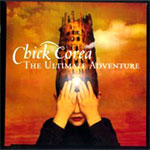
fiction novel To The Stars. And in 2005, he returned to Hubbard
for further musical inspiration, this time interpreting The Ultimate
Adventure, an exotic blend of passionate flamenco melodies, North
African and Middle Eastern grooves and adventurous improvisation.
Without doubt Chick Corea one of the most prolific
composers of the second half of the 20th century. From avant-garde
to bebop, from children’s songs to straight ahead, from hard-hitting
fusion to heady forays into classical, Corea has touched an astonishing
number of musical bases in his illustrious career. He continues
to explore and generate new material for a number of different vehicles.
Béla fleck biography
Born and raised in New York City, Fleck began his
musical career playing the guitar. In the early 1960’s, while
watching the Beverly Hillbillies, the bluegrass sounds of Flatt
& Scruggs flowed out of the TV set and into his young brain.
Earl Scruggs's banjo style hooked Fleck’s interest immediately.
It wasn't until his grandfather bought him a banjo
in September of 1973, that it became his full time passion. That
week, Fleck entered New York City’s, High School of Music
and Art. He began studies on the French horn but soon switched to
the chorus. Since the banjo wasn’t an offered elective at
Music & Art, Fleck sought lessons through outside sources. Erik
Darling, Marc Horowitz, and Tony Trischka stepped up and filled
the job. Fleck joined his first band, ‘Wicker's Creek’
during this period. Living in NYC, Fleck was exposed to a wide variety
of musical experiences. One of the most impressive was a concert
by “Return to Forever” featuring Chick Corea and Stanley
Clarke. This concert encouraged further experimenting with bebop
and jazz on the banjo, signs of things to come.
Several months after high school, Fleck moved to
Boston to play with Jack Tottle's Tasty Licks. While in Boston Fleck
continued his jazz explorations, made two albums with Tasty Licks,
and his first solo banjo album “Crossing the Tracks”,
on Rounder Records. This is where he first played with future musical
partners Sam Bush and Jerry Douglas.
After the break up of Tasty Licks, Fleck spent
a summer on the streets of Boston playing with bass player, Mark
Schatz. SchatZ and Fleck moved to Lexington, KY to form Spectrum,
which included Jimmy Gaudreau, Glen Lawson, and Jimmy Mattingly.
In 1981, Fleck was invited to join the progressive
bluegrass band New Grass Revival, lead by Sam Bush on mandolin,
fiddle and vocals. With the addition of California based Pat Flynn
on guitar and NGR veteran John Cowan on bass and vocals, New Grass
Revival took bluegrass music to new limits, exciting audiences and
critics alike.
During the 9 years Fleck spent with NGR he continued
to record a series of solo albums for Rounder, including the ground
breaking 1988 album “Drive”. He also collaborated with
Sam Bush, Jerry Douglas, Edgar Meyer and Mark O'Connor in an acoustic
super group called Strength in Numbers.
Towards the end of the New Grass years, Fleck and
Howard Levy crossed paths at the Winipeg Folk Festival. Next came
a phone call from a friend of Fleck’s, wanting to introduce
to him, a new bass player who was in town looking for a gig. Victor
Lemonte Wooten played some licks on the phone for Fleck and the
second connection was made. In 1988 Dick Van Kleek, Artistic Director
for the PBS Lonesome Pine Series based in Louisville, Kentucky,
offered Fleck a solo show. Fleck put several musical sounds together
with his banjo, a string quartet, his Macintosh computer and also
a more jazz based combo. Howard and Victor signed on for the concert,
but the group still lacked a drummer. The search was on for an unusual
drummer/percussionist. Victor offered up his brother Roy Wooten,
later to become known as FutureMan. The first rehearsal held at
Fleck’s Nashville home was hampered by a strong thunderstorm
that knocked the electricity out for hours. The four continued on
with an acoustic rehearsal and the last slot on the TV show became
the first performance of Béla Fleck and the Flecktones. This
group would tour and produce successful albums for many years.
Collaborating with Fleck on "Perpetual Motion"
was his long time friend and colleague Edgar Meyer, a bassist whose
virtuosity defies labels and also an acclaimed composer. In the
wake of that album's release, Fleck & Meyer came up with the
idea of a banjo/bass duo, which they developed and refined during
a concert tour of the US.
The recipients of Multiple Grammy Awards going
back to 1998, Béla Fleck & the Flecktones picked up the
Best Contemporary Jazz Performance, Instrumental Grammy in 2000
for “Outbound”, a typically wide-ranging project, with
guest artists that include guitarist Adrian Belew and singers Jon
Anderson and Shawn Colvin, built around Fleck’s concept of
“the banjo being weird.” Flecks’ total Grammy
count is 8 Grammys won, and 20 nominations. He has been nominated
in more different categories than anyone in Grammy history.
|