|
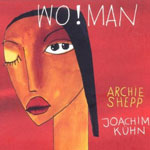
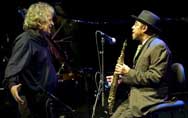
Archie Shepp & Joachim kuhn
@ the Queen Elizabeth hall, Southbank Centre
17 November 2011
Click an image to enlarge.
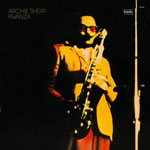
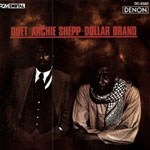
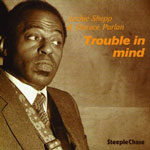
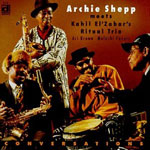
Archie Shepp biography
Saxophone player, composer, pianist, singer, politically
committed poet, playwright, Archie Shepp is a legend.
Archie Shepp was born in 1937 in Fort Lauderdale
in Florida. He grew up in Philadelphia, studied piano and saxophone
and attended high school in Germantown; he went to college, became
involved with theatre, met writers and poets, among them, Leroy
Jones and wrote: ‘The Communist,’ an allegorical play
about the situation of black Americans. In the late fifties, Archie
Shepp also met the most radical musicians of the time: Lee Morgan,
Bobby Timmons, Jimmy Garrisson, Ted Curson, Beaver Harris…
his political consciousness found an expression in plays and theatrical
productions which barely allowed him to make a living. In the beginning
sixties he met Cecil Taylor and did two recordings with him which
were determining. In 1962 he signed his first record with Bill Dixon
as co-leader. During the following year, he created the New York
Contemporary Five with John Tchichai, made four records for Fontana,
Storyville and Savoy and travelled to Europe with this group.
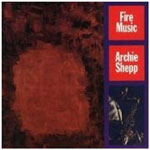
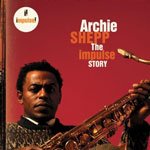
Starting in August 1964, he worked with Impulse
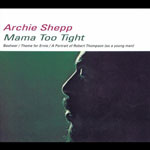
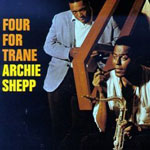
and made 17 records among which, “Four For Trane,” “Fire
Music,” and “Mama Too Tight,” some of the classics
of Free Music. His collaboration with John Coltrane materialised
further with “Ascension in” 1965, a real turning point
in Avant-Garde music. His militancy was evidenced by his participation
in the creation of the Composers Guild with Paul and Carla Bley,
Sun RA, Roswell Rudd and Cecil Taylor.
In July 1969 he went for the first time to Africa
for the Pan African Festival in Algiers where many black American
militants were living. On this occasion he recorded “Live
for Byg” the first of six albums in the Actual series.
In 1969 he began teaching Ethnomusicology at the
University of Amherst, Massachusetts; at the same time he continued
to travel around the world while continuing to express his identity
as an African American musician. The dictionary of Jazz (Robert
Laffont, Bouquins) defines him in the following way: “A first
rate artist and intellectual, Archie Shepp has been at the head
of the Avant- Garde Free Jazz movement and has been able to join
the mainstream of Jazz, while remaining true to his esthetic. He
has developed a true poli-instrumentality: an alto player, he also
plays soprano since 1969, piano since 1975 and more recently occasionally
sings blues and standards.”
He populates his musical world with themes and
stylistic elements provided by the greatest voices of jazz: from
Ellington to Monk and Mingus, from Parker to Siver and Taylor. His
technical and emotional capacity enables him to integrate the varied
elements inherited by the Masters of Tenor from Webster to Coltrane
into his own playing but according to his very own combination:
the wild raspiness of his attacks, his massive sound sculpted by
a vibrato mastered in all ranges, his phrases carried to breathlessness,
his abrupt level changes, the intensity of his tempos but also the
velvety tenderness woven into a ballad. His play consistently deepens
the spirit of the two faces of the original black American music:
blues and spirituals. His work with classics and with his own compositions
(Bessie Smith’s Black Water Blues or Mama Rose) contributes
to maintaining alive the power of strangeness of these two musics
in relationship to European music and expresses itself in a unique
mix of wounded violence and age-old nostalgia.
The scope of his work which registered in the eighties
a certain urgency (at the cost of a few discrepancies) is a witness
to the fact that in 1988 Archie Shepp was with Sonny Rollins one
of the best interpreters in the babelian history of jazz. With his
freedom loving sensitivity Archie Shepp has made an inestimable
contribution to the gathering, the publicizing and the inventing
of jazz.
Joachim Kühn biography
After becoming a professional jazz musician in
1961, German pianist Joachim Kühn has for many years been a
higly respected performer of European improvised music.
Although not a free jazz musician, per se, Kuhn
has been an avant-gardist; he began attempting a fusion of contemporary
classical elements with jazz very early in his career.
Kuhn's intense virtuosity is a reflection of his
training. He studied classical composition and piano for 12 years,
beginning when he was a small child. He performed as a classical
pianist up until 1961, at which point he began playing in a Prague-based
jazz quintet. He led a trio from 1962-1966, and in 1964 began playing
with his much-older brother Rolf Kuhn, an accomplished clarinetist.
In the '70s, Joachim Kuhn led his own groups, and
played with the violinist Jean-Luc Ponty. Kuhn had a measure of
commercial success in the '70s. Geographically and musically speaking,
Kühn was furthest apart from Europe during the second half
of the 70's when he lived in California and joined the West Coast
fusion scene. Crossover stars, such as Alphonse Mouson, Billy Cobham,
Michael Brecker, and Eddie Gomez participated in his recordings.
Simultaneously, he was frequently to be heard solo and in a duo
with Jan Akkerman.He has also worked with Focus guitarist Philip
Catherine.
His star faded a bit in the '80s, but Kuhn kept
active, playing challenging forms of jazz and recording occasionally.
A 1997 release, “Colors” Live From Leipzig, a duo with
Ornette Coleman, helped fuel new interest in Kuhn; both men were
in top form and the album received excellent reviews.
|





























crbw.jpg)
.jpg)
.jpg)
bwred.jpg)
bwred.jpg)
bw.jpg)
.jpg)
bwred.jpg)
.jpg)
.jpg)
bw.jpg)
.jpg)
bw.jpg)
bw.jpg)
.jpg)
bw.jpg)
.jpg)
bw.jpg)