|
Click an image
to enlarge. (main text only)
There comes a time in every hi-fi
enthusiast’s life when you sit back in your dedicated listening
chair and contemplate. Perhaps you may have read a recent review
of the latest CD player, amplifier or turntable proclaiming the
next revelation in sound quality. Your ears may still be ringing
(not literally) after listening to a multi- thousand pound set-up
at a recent hi-fi show? Whatever the reason – You now want
to squeeze MORE out of your cherished hi-fi system.
There was no doubt my Linn LP12 Sondek was in need
of more than a little TLC. For the past few months I had become
accustomed to giving the platter a helping hand on its way to 33
rpm and I had long given up the arduous task of removing the platter
etc in attempt to reach top speed of 45 rpm. The Valhalla psu board
had finally gone to Valhalla heaven so I was forced to make a decision.
1. Buy a used Valhalla board from ‘that’
online auction site.
2. Replace the turntable.
3. Upgrade to an off-board power supply.
I quickly settled on the fact that this was definitely
an opportunity for an upgrade, so I ruled out buying used Valhalla
board. As there have been a few new exciting turntable designs over
the past ten years it seemed a good idea to at least investigate,
so I auditioned a few – Namely the SME 10A, Musical Fidelity’s
M1 and Avid’s Volvere, admittedly not always under the greatest
conditions. Nevertheless I was extremely impressed with all of the
above, but as cost was a major factor my wandering ambitions soon
came back down to earth. An off-board power supply was the most
viable cost effective solution.
It is difficult to audition different off-board
psu’s for obvious reasons but after basic investigation three
names continuously came to the forefront: Linn’s Lingo, Heed’s
Orbit, and Origin Live. Deeper investigation into the characteristics
of all three options finally led me to Origin
Live.
Why is the motor and power supply so
influential on sound
quality? (Article from Origin Live)
The reasons why superior power supplies have
such an audible effect on performance have been well documented
– they reduce vibration and variation in motor speed –
both of which have a huge effect on the signal generated by the
“all sensing” stylus. What may not be so generally appreciated
is that platters suffer a momentary slowing under load which is
so small it can hardly be measured. The cartridge amplifies this
effect 8,000 times, resulting in an appreciable loss of dynamic
impact, especially in the bass region. To overcome this, some decks
use a very high mass platter but this “solution” has
its own drawbacks, producing a thick clinical and lifeless sound.
A better solution is to make the motor capable of responding powerfully
and instantaneously to any increase in the dynamic load on the drive…
Origin Live solutions
Origin Live offer three upgrade solutions with
Prices ranging from £250.00 for the Standard DC Motor Kit,
£339.00 for the Advanced and £570 for the Ultra. Two
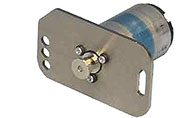
optional turntable motors are available – The DC100 £79.00
and the DC200 at £189.00. An upgrade transformer is also available
at £175.00. Discounts are offered if motor kits and transformer
are purchased together. Origin Live also offer a no quibble refund
on all units if it not to your liking. The Ultra Motor kit including
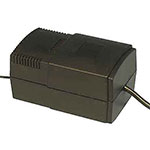
the DC200 Motor and Upgrade Transformer was chosen for my LP12.
Installation
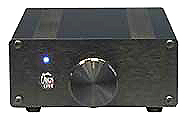
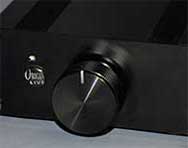
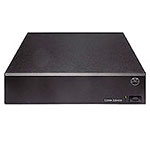
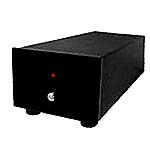
The Ultra kit includes the Ultra switch box (allows
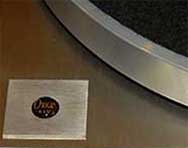
easy switching between 33/45 rpm) a stylish brushed stainless steel
‘Origin Live’ logo plate (to fit over the original LP12
switch aperture) a speed strobe card and a clear installation instruction
manual. You will need to be able to access the underside of your
turntable comfortably to ensure precise fitting of the new DC motor.
The use of a Linn set-up jig would be handy for this task. I would
class myself as pretty handy with a screwdriver, but I left fitting
of motor and initial set up to my local friendly dealer
(The Cartridge Man).
 |
First listening test
The first rather rushed test of my newly set up LP12 left me somewhat
confused. Donny Hathaway’s “A Song For You” (Donny
Hathaway In Performance) definitely sounded cleaner with his voice
and instruments having greater detail overall, but Hathaway seemed
to be in a hurry to finish his set, pack up and get home. Chords
that normally rolled beautifully off his keyboard sounded shaky
and lack lustre. After a brief chat with the Cartridge Man and a
scan of the Origin Live manual I realised the platter speed required
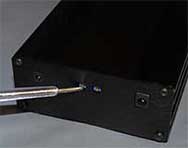
a little fine-tuning. This adjustment is easily done by turning
two small screws at the back of the Ultra switch box clockwise or
anti-clockwise. To set the speed accurately you are advised to place
the strobe card on the platter and direct a standard light bulb,
or fluorescent light on the disc to calibrate 33/45 rpm. After several
failed attempts to read the strobe card with a normal bulb I managed
to hook up a makeshift fluorescent tube near the turntable. This
was the cheapest and most effective way of utilising the speed strobe
card and calibrating 33/45 rpm.
Final verdict
The Origin Live Ultra upgrade does much more than
open up the soundstage. Lively classics such as Toto’s
“Africa” never failed to get my feet tapping before
the upgrade. After the upgrade my whole body struggled to remain
static in my listening chair. I just had to rock naturally in time
with Jeff Porcaro’s stirring drums. I could feel added weight
and hear greater depth in Porcaro’s drum kit. There was a
tighter, more controlled grip on all instruments generally. The
eclectic colourful harmonics of Joe Zawinul’s keyboards on
Weather Report’s “Birdland” were delivered stronger
and deeper than ever before. You also got a strong sense of individual
musicians drive energy and space. Stevie Wonder’s “Do
I Like You” (Hotter Than July) has a tight driving synthesised
rhythm with punchy bass. Prior to the Ultra upgrade the rhythm section
tended to sound disjointed with muddy bass. After the upgrade everything
jelled beautifully. The rhythm section flowed with ease and the
bass sounded deep tight and controlled. David Sanborn’s seductive
alto on “It’s You” from his “Double Vision”
album made the hairs stand up on the back of my neck (A sensation
I had only experienced when listening to Sanborn live). Sanborn’s
precise powerful alto had a ‘sweet’ quality, especially
in the higher register. With the Origin Live Ultra in place any
possible sharpness seemed to be smoothed out. This characteristic
may not be suitable for all tastes, but I found I was able to listen
to specific recordings at higher volumes.
It took a month of serious listening, revisiting
albums that sat dormant in my collection for years to fully appreciate
the transformation this upgrade made. You find yourself listening
to album tracks you initially considered album fillers.
If you sit near your turntable you may notice
a slight rattle from the DC motor (and I do mean slight). This does
quieten as the motor runs in and definitely does not impair your
listening pleasure in anyway.
Being somewhat cynical of some manufacturers claims,
I expected the Origin Live Ultra upgrade to provide a subtle change
in overall sound. I was wrong. The improvement this upgrade
has made to my LP12 was dramatic. Even more shocking was to
receive positive comments from a guest who walked into the room
“wow that sounds extremely live.” A comment
from someone who had never expressed an interest in music whatsoever
and thought the term ‘vinyl’ referred only to a tabletop
covering!
Insure you have nothing to do for
a good few hours after installing the Origin Live Ultra, once your
treasured vinyl albums start spinning you won’t want them
to stop. Not even an all expenses paid dinner date with Halle Berry
with guaranteed afters served in a five star hotel suite would have
dragged me from my listening chair.
Full component list:
Linn LP12 turntable. ITOC LVII arm. Dynavector D10X5 cartridge
Musical Fidelity A3CR amplifier
Musical Fidelity A3CR Dual Mono pre-amplifier
Martin Logan Scenario Electrostatic speakers
Van den Hull First & Second interlink cables
Chord Legend speaker cable
Campaign Audio Design Conqueror Elite 6 way mains adaptor
Malik Hamid
© Michael Valentine Studio
January 2008.
|