Hugh Masekela biography
Hugh Masekela Desert Island Discs
Which 2 albums would you take with you to
a desert island?
“If I was on a desert island I would
not need any music I would listen to the birds and the sea!”
However… I guess if I had to take two albums…
Louis Armstrong – The Ultimate Collection
Miles Davis – Kind Of Blue
Ever since the day in 1954 when Archbishop Trevor
Huddleston gave him his trumpet, Masekela has played music that
closely reflects his beginnings as a little boy in Witbank. The
street songs, church songs, migrant labour work songs, political
protest songs and the sounds of the wide cross-section of ethnic
culture South Africa possesses from Xhosa, Zulu, Swazi, Khoi,
San, Griqua, Sotho and Tswana peoples of the South, South East,
Central and Western Regions to the Ndebele, Tsonga, Venda and
Pedi provinces of the North and North West. The urban sounds of
the townships, the influences of the Manhattan Brothers, Dorothy
Masuka, the Dark City Sisters, the Mahotella Queens and Mahlathini,
Ladysmith Black Mambazo, Miriam Makeba, Spokes Mashiyane, Lemmy
Mabaso, Elijah Nkwanyana, Kippie Moeketsi, Mackay Davashe, all
these form an intrinsic part of his musical roots, intertwined
with vivid portraits of the struggles and the sorrows, the joys
and passions of his country.
After Huddleston asked the leader of the Johannesburg
“Native” Municipal Brass Band, Uncle Sauda to teach
him the rudiments of trumpet playing, Masekela quickly proceeded
to master the instrument after having been inspired by the film
“Young man with a horn” in which Kirk Douglas portrayed
the great American Jazz trumpeter,Bix Beiderbecke. Soon, some
of his music loving schoolmates also became interested in playing
instruments, leading to the formation of the Huddleston Jazz Band,
South Africa's very first youth orchestra formed at St. Peters
Secondary
School where the anti-apartheid priest was chaplain.
Huddleston was deported by the racist government
of the time for his emancipation militancy and when Masekela kept
on badgering him to help him leave the oppressive country for
music education opportunities abroad, the priest worked very hard
to get him to England. After playing in other dance bands led
by the great Zakes Nkosi, Ntemi Piliso, Elijah Nkwanyana and Kippie
Moeketsi among others, he joined the star studded African Jazz
Revue in 1956. Following a Manhattan Brothers tour of the country
in 1958, he ended up playing in the orchestra for the “King-Kong”
musical written by Todd Matshikiza, with Jonas Gwangwa and some
of the afore mentioned musicians. “King-Kong” was
South Africa's first record breaking blockbuster
theatrical success that toured the country for a sold out year
with Miriam Makeba and the Manhattan Brothers’ Nathan Mdledle
in the lead. The musical later went to London’s West End
for two years. At the end of 1959, Abdullah Ibrahim, Kippie, Jonas,
Makhaya Ntshoko, Johnny Gertze and Hugh formed Jazz Epistle Verse
1, the Hugh Masekela first African group to record an LP and perform
to record-breaking audiences in J.H.B. & CapeTown through
late 1959 to early 1960.After the March 21, 1960 Sharpville Massacre
where 69 Africans peacefully protesting the pass laws along with
thousands of their fellow comrades were mercilessly mowed down,
the ensuing national outrage caused the government to proclaim
a state of emergency and the banning of gatherings by more than
ten people.
As the brutality of the Apartheid state increased,
Masekela finally left the country with the help of Trevor Huddleston
and his friends Yehudi Menuhin and Johnny Dankworth who got him
admitted into London's Guildhall School of music. Miriam Makeba
who was already enjoying major success in the USA later helped
him with Harry Belafonte, Dizzy Gillepsie and John Mehegan, to
get admission to the Manhattan school of Music in New York. Hugh
finally met Louis Armstrong who had sent the Huddleston Band a
trumpet after Huddleston told the trumpet king about the band
he helped start back in South Africa before his deportation. With
immense help from Makeba and Belafonte, Masekela eventually began
to record, gaining his first breakthrough with “The Americanization
of Ooga-Booga” produced by the late Tom Wilson who had been
producer of Bob Dylan and Simon & Garfunkel’s debut
successes. Stewart Levine, his business partner in Chissa Records
went on to produce hit records for Masekela on Uni Records, beginning
with the “Emancipation of Hugh Masekela” followed
by “Alive and Well at the Whiskey” in 1967 and then
“Promise ofA Future” which contained the gigantic
hit song “Grazing in the Grass” in 1968.
By the beginning of the 1970’s he had attained
international fame, selling out all of America’s festivals,
auditoriums and top niteries. Heeding the call of his African
roots, he moved to Guinea, then Liberia and Ghana after recording
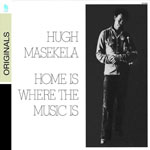
the historical “Home is where music is” with Dudu
Pukwana. After a pilgrimage to Zaire in 1973, Masekela met Fela
Kuti in Nigeria who introduced him and Stewart Levine, to “Hedzoleh
Soundz” a grassroots Ghanaian band. For the next five years
they produced a string of ground breaking records, which included
international favourites such as “The Marketplace”,
“Ashiko”. “The Boy’z doin it”, “Vasco
Da Gama”, “African Secret Society” and the evergreen
“Stimela”. After a tour and two duet albums with Herp
Albert, Masekela and Miriam played a Christmas Day concert in
Lesotho in 1980 where 75 000 people came to see them after they
had been away for 20 years from the region. In 1981, Hugh moved
to Botswana where he started the Botswana international School
of Music with Dr. Khabi Mngoma. His record label Jive Records,
helped him to set up a mobile studio in Gaborone where Stewart
produced “Techno Bush” from which came the hit single
“Don’t Go Lose it Baby” in 1984. He unexpectedly
had to leave with his band Kalahari for England, Hugh Masekela
after his childhood friend George Phahle, his wife Lindi Phahle
along with 14 people were murdered by South African defence force
death squads in the pretext of raiding “communist terrorist
camps”manned by South African Anti-apartheid activists.
While in England, Masekela conceived the Broadway musical “Sarafina”
with Mbongeni Ngema and recorded another runaway song “Bring
Back Nelson Mandela bring him back home to Soweto” with
Kalahari in 1986. After touring in “Graceland” with
Paul Simon, Black Mambazo and Miriam Makeba, Masekela returned
home following the unbanning of political parties and the release
of Nelson Mandela in 1990. In 1991, he launched his first tour
of South Africa called “Sekunjalo, This is it” with
Sankomota and Bayete. It was a four-month tour, selling out in
the country’s major cities. His recent albums “Black
to the Future”, “Sixty”, “Greatest Hits”
and “Time” have all gone platinum. 2004 saw the publishing
of “Still grazing” Masekela’s biography which
was published by Random House in New York.
Masekela uses his position to give a platform
to a fresh generation of South African talent, some of whom will
be performing with him on his tours. Masekela was heavily influenced
by African-American music since his infancy, having been raised
on the 78 RPM gramophone records of Louis Armstrong, Jelly Roll
Morton, Bessie Smith, Ma Rainey, Chick Webb, Ella Fitzgerald,
Sy Oliver, Lucky Millinder, Duke Ellington, Count Basie, Erskine
Hawkins, Coleman Hawkins, Cab Calloway, Fats Waller, Sarah Vaughan,
Billy Eckstine, Louis Jordan, The Ink Spots, The Mills Brothers,
Billie Holiday and Charlie Christian. In his teens, he fell in
love with Dizzy Gillepsie, George Shearing, Miles Davis, Clifford
Brown, Coltrane, Cannonball, Horace Silver, Art Blakey, Lee Morgan,
Kenny Dorham, Oscar Peterson, Bud Shank, Dave Brubeck, Paul Desmond,
Stan Getz, Jackie & Roy Kral, June Christy, Shorty Rogers,
Gerry Mulligan, Chet Baker, Bud Powell, and Mahalia Jackson. He
went to Manhattan School of Music with Dave Grusin, Herbie Hancock,
Chick Correa, David Izenzon, Donald Byrd, Eric Dolphy, Edie Gomez,
Richard
Davis, Ron Carter and many other jazz greats.
Masekela played on some of Bob Marley’s
very first recordings and his music has very strong Brazilian,
Nigerian, Ghananian and Congolese influences. Hugh Masekela has
just released a new album called “Revival” produced
by Zwai Bala and Godfrey ‘Guffy’ Pilane, both of whom
are considered to be hip hop, kwaito musicians. However their
collaboration with Masekela destroys that myth and shows them
to be extremely gifted and well rounded musicians instead. Hugh
Masekela has also just recorded an album of old and popular standard
ballads with a trio led by his Manhattan School of music classmate
Larry Willis from 43 years ago. Larry played piano in Masekela’s
debut American quartet which recorded the classic “The Americanization
of Ooga Booga” album in 1965. Along with bassist John Heard
and drummer Lorea Hart, they completed a 3 day live recording
of the love songs. This had been a dream of theirs for 4 decades.
The album is called “Almost like being in Jazz” and
was released in 2007. In the last years Hugh Masekela toured the
USA, Europe, Asia and his home country extensively. Numerous new
recordings and some remixes of his most successful cd’s
were released.
In summer 2007, Masekela embarked on a tour of
the United States and Canada in support of the live recording,
“Hugh Masekela: Live at the Market Theatre”, touring
with most of the band mates that supported his highly regarded
album, “Uptownship”. Since October 2007 he is a Board
Member of the Woyome Foundation (THE WOYOME FOUNDATION FOR AFRICA
(WOFA) is an International Charity Foundation registered in Ghana
with a strategic thrust of launching a new offensive in the fight
against HIV/AIDS.).
Larry Willis biography
Larry Willis was born in 1942 in Manhattan’s
Harlem. Surprisingly, he entered music not as a pianist but as
a voice major, first at New York’s High School of Music
and Art for gifted students, then at the Manhattan School of Music.
His senior year in high school, at 17, he had his first recording
date, a classical gig with the Music and Arts Choral Ensemble
singing a Copland opera conducted by no less then Leonard Bernstein.
But something even more important than that happened
to Willis at the beginning of that senior year. He started playing
the piano - no lessons, no teacher, just figuring it out by himself.
By the end of the winter, he was playing his first professional
gigs in a jazz trio with two of his classmates, Al Foster on drums
and Eddie Gomez on bass. No one knew it then, but that little
trio was probably the most distinguished high school jazz group
in the country.
Soon after entering the Manhattan School of Music,
Willis switched from voice to music theory. For one, he was running
head-on into the all-too-evident barriers facing black musicians
in the classical world.
On the positive side, Willis’ interest
in jazz was turning into passion. A fellow student, Hugh Masakela,
heard him jamming with Al Foster. Masekela was so impressed that
he hooked Willis up with John Mehegan, the legendary New York
jazz piano teacher. Those were Willis’ first-ever lessons.
By the end of that year at the Manhattan School, at age 19, Willis
was playing regularly with Jackie McLean, the great alto saxophone
innovator.
I know of no more remarkable entry into jazz:
a kid of 17 decides to play the piano for the first time; four
months later, he’s playing gigs with a soon-to-be world
class trio. A year and a half after that, he’s making jazz
history with the next giant of the alto after Bird. Talk about
a natural gift!
A year after Willis’ graduation in 1965,
Jackie McLean gave him his first recording date - Right Now, on
Blue Note - and on that first date recorded the first two pieces
in a continuing stream of Willis compositions.
Since then, Larry Willis has played on more than
300 records. He’s played or recorded with almost every great
jazz musician of the modern era, stars like Dizzy Gillespie, Lee
Morgan, Woody Shaw, Hugh Masakela, Cannonball and Nat Adderley,
Stan Getz, Art Blakey, Art Taylor, Clifford Jordan, Carmen McRae,
and Shirley Horn. His most recent CDs include a Larry Willis Quintet
and four Larry Willis Trio recordings plus two solo sessions (labels
are Audioquest, Steeplechase, Evidence and Mapleshade).
Willis’ extraordinary versatility as a
pianist ranges from rock and pop - he spent 7 years as keyboardist
for Blood, Sweat and Tears - to African, Brazilian and Afro-Cuban
music. He’s one of the only non-Hispanic players who ever
impressed Mario Bauza as a Latin pianist.
Edited by Robin Francis
© Michael Valentine Studio
.jpg)
.jpg)
cr.jpg)
cr.jpg)
cr.jpg)
cr.jpg)
.jpg)
.jpg)
Further
Recommended
Viewing |
Click Larry Willis' image to see
him @ the PizzaExpress Jazz Club in 2014,
Hugh Masekela's images below to see him @ the Royal Festival Hall
in 2010,
or @ the Hackney Empire (Celebrate Mama Africa) in 2011...
Go
back to the London Jazz Festival 2013 home page.
Go
back to the jazz gallery.
[ Top ]






























_150prev.jpg)
_150prev.jpg)
_150prev.jpg)