Biography
Charles Lloyd was born March 15, 1938 in Memphis,
Tennessee. From an early age, he was immersed in that city's rich
musical life and was exposed to jazz. He began playing the saxophone
at the age of 9. Pianist Phineas Newborn became his mentor, and
took him to Irvin Reason for lessons. Lloyd worked in Phineas
Sr’s band, and from the age of 12 worked as sideman in the
blues bands of B.B. King, Howlin’ Wolf, Johnnie Ace, Bobbie
“Blue” Bland, and others. His closest friend in high
school was trumpeter, Booker Little.
In 1956 Lloyd moved to Los Angeles and earned
a Master’s degree from the University of Southern California.
During this period Lloyd played in Gerald Wilson’s big band
and he also had his own group that included Billy Higgins, Don
Cherry, Bobby Hutcherson, and Terry Trotter. Lloyd joined Chico
Hamilton in 1960, though the band was known for playing “chamber
jazz” at the beginning of Lloyd's tenure. His influence
as a composer and a player quickly pushed it in a more progressive
post-bop direction especially after Hamilton asked him to be the
group’s “music director.” Lloyd's key musical
partner in the band was Hungarian guitarist, Gabor Szabo. In 1964
Lloyd left Hamilton's group to join alto saxophonist Cannonball
Adderly. During this period he recorded two albums as a leader
for Columbia Records, Discovery and Of Course, Of Course; his
sidemen were other young musicians including Herbie Hancock, Ron
Carter, and Tony Williams. Through 1965-1969 Lloyd led a quartet
with pianist, Keith Jarrett, bassist, Cecil McBee (later, Ron
McClure), and drummer, Jack DeJohnette. The quartet's music was
an interesting fusion of straight-ahead post-bop, free jazz and
world music which quickly caught the attention of both jazz fans
and critics. They also achieved a fair amount of crossover success
with young rock fans and became the first jazz group to play at
The Fillmore. Lloyd’s album “Forest Flower, Live at
Monterey,” became a big commercial hit, largely on the strength
of the title track. Other noteworthy albums include “Dream
Weaver,” “Soviet Union,” and “In Europe,”
all on Atlantic.
In 1970, after the quartet disbanded, Lloyd moved
back to California and entered a state of semi-retirement. He
practically disappeared from the jazz scene, but can be heard
on recordings with the Doors, Canned Heat, and the Beach Boys.
Occasionally during the 1970s Lloyd played with The Beach Boys;
both on their studio recordings and as a member of their touring
band.
Upon being approached by pianist, Michel Petrucciani
in 1981, he resumed playing actively for two years and then retreated
again. Upon his recovery from a near death experience in 1986,
Lloyd decided to rededicate himself to music. He started performing
occasionally in 1987 & 88. In 1989, Lloyd re-established an
active touring schedule and began recording for ECM Records. The
first ECM release was “Fish Out of Water” with Bobo
Stenson, Palle Danielsson, and Jon Christensen. The ECM recordings
showcased his sensitivity as a ballad player and composer. Between
1993 and 1997 the quartet included Bobo Stenson, Anders Jormin,
and Billy Hart. In 1998 the Billy Higgins replaced Hart, and Lloyd
alternated between Stenson and John Abercrombie. Noteworthy albums
include “Canto,” “Voice In The Night,”
“The Water Is Wide” (featuring Brad Mehldau, John
Abercrombie, Larry Grenadier and Billy Higgins). Geri Allen replaced
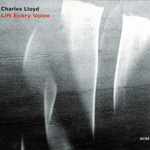
Stenson, touring and recording with Lloyd between 2001and 2006
(Lift Every Voice and Jumping the Creek). Drummer, Eric Harland
joined Lloyd’s quartet in 2002, following Billy Higgins’
passing, and is also a part of Lloyd’s Sangam trio formed
in 2004 with tabla master, Zakir Hussain. They continue to perform
and record together.
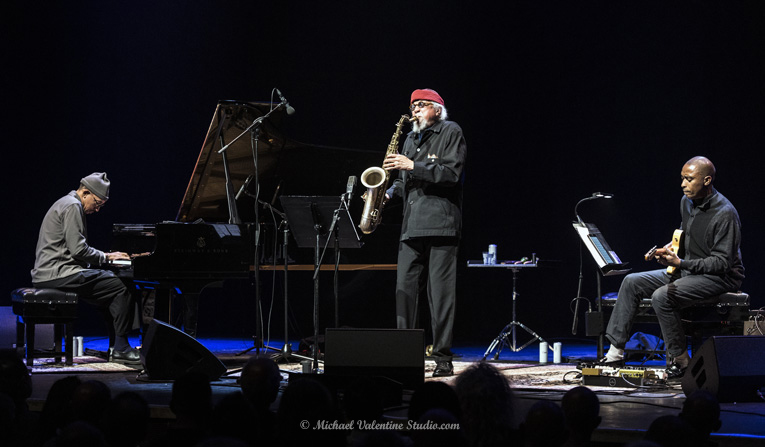
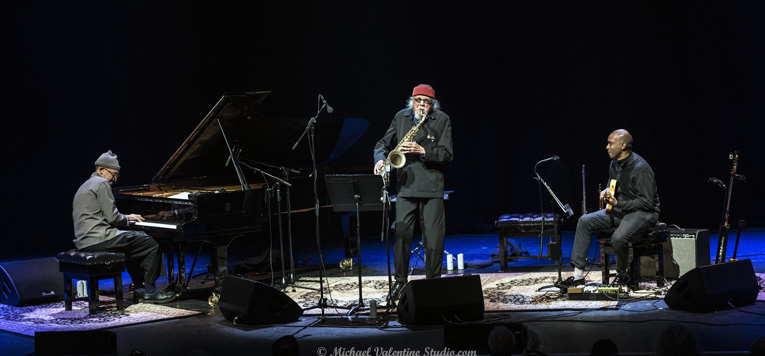
Featured musicians: Charles Lloyd –
tenor saxophone, Anthony Wilson - guitar
and Gerald Clayton - piano


Further
Recommended
Viewing |
Click the image below to see charles Lloyd @
the Barbican Centre, 2014...
Go
back to the London Jazz Festival 2023 home page.
Go
back to the jazz gallery.
[ Top ]